
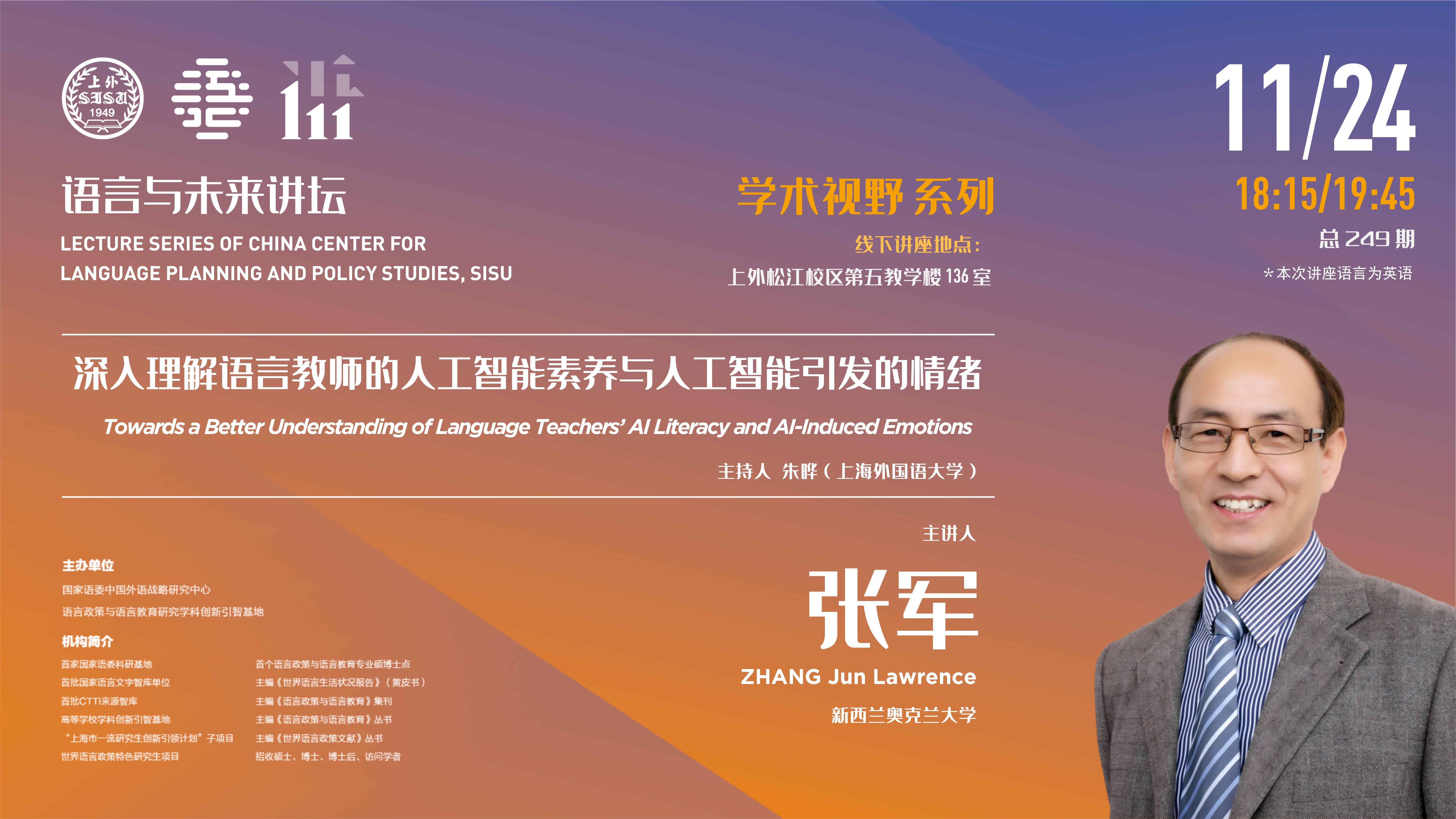
题目 | 深入理解语言教师的人工智能素养与人工智能引发的情绪 Towards a Better Understanding of Language Teachers’ AI Literacy and AI-Induced Emotions |
主讲人 | 张军(新西兰奥克兰大学) |
主持人 | 朱晔(上海外国语大学) |
讲座语言 | 英语 |
时间 | 11月24日(周一)18:15-19:45 |
地点 | 上外松江校区第五教学楼136室 |
内容提要
Artificial intelligence (AI) has emerged as a pivotal force driving innovation and transformation in language education. However, the dual challenge of enhancing teachers’ AI literacy and understanding their emotional experiences in AI-mediated teaching remains largely unexamined. AI literacy among teachers encompasses not only technical knowledge of AI applications but also an understanding of their pedagogical implications, ethical considerations, and the ability to critically evaluate and implement these technologies effectively in the classroom. Without sufficient AI literacy, educators may struggle to maximise the benefits of AI tools, potentially leading to ineffective implementation or resistance to technological integration. Equally crucial is an examination of language teachers’ emotional responses to AI-driven teaching environments. The introduction of AI can evoke a range of emotions, from enthusiasm and curiosity to anxiety and apprehension. Understanding these emotional experiences is vital in developing strategies to support teachers in navigating AI-mediated instruction, ensuring that they feel empowered rather than overwhelmed by these technological advancements. As AI continues to reshape pedagogical practices, it is essential to explore how language educators navigate its integration, both in terms of cognitive adaptation and affective responses.
To fill the research gap, we conducted a systematic review to identify relevant studies published in SSCI-indexed journals within the Web of Science Core Collection (WOSCC) to show the research trend. The review uncovered existing research on AI literacy among language teachers and their emotional responses to AI-driven teaching and learning processes. Building upon appraisal theory, we further propose a novel framework that elucidates the intricate interplay between AI literacy and AI-induced emotions within the context of applied linguistics and/or language education. This framework serves as a foundational step towards developing strategic interventions and professional development programmes that support language teachers in adapting to the ever-evolving AI-mediated pedagogical landscapes. Ultimately, bridging AI literacy with an awareness of emotional responses will enable educators to harness AI’s potential while mitigating its challenges, ensuring a balanced and sustainable integration into applied linguistics and/or language education practices.
主讲人简介
Lawrence Jun Zhang, PhD, a past Post-doctoral Fellow at the Department of Education, Oxford University, UK, is Professor of Applied Linguistics/TESOL and Associate Dean for the Faculty of Arts and Education, University of Auckland, New Zealand. His major interests are in learner metacognition, the psychology of language learning and teaching, and teacher education, with particular reference to EFL reading/writing development and ESP/EAP. He has published extensively along these lines in leading international journals, including Applied Linguistics, Applied Linguistics Review, Computers and Education, Computers in Human Behaviour, Learning and Instruction, Learning and Individual Differences, Computer Assisted Language Learning, Current Psychology, Metacognition and Learning, Journal of Psycholinguistic Research, Perceptual and Motor Skills, Modern Language Journal, International Journal of Applied Linguistics, Studies in Second Language Acquisition, System, TESOL Quarterly, Reading and Writing, Reading & Writing Quarterly, Journal of Second Language Writing, Journal of Multilingual and Multicultural Development, Language Teaching Research, Discourse Processes, among others. He was the sole recipient of the “Distinguished Research in TESOL Award” in 2011 for his article, “A dynamic metacognitive systems perspective on Chinese university EFL readers”, published in TESOL Quarterly, 44(2). He is serving on the editorial boards of several international journals. In 2016 he was honoured with the recognition by the TESOL International Association (USA) with the award of “50@50”, which acknowledged “50 Outstanding Leaders” around the globe in the profession of TESOL at TESOL’s 50th anniversary celebration in Baltimore, Maryland. In November 2016, he was successfully elected to the International TESOL Association’s Board of Directors. In the Stanford University Rankings, he has been consecutively listed in the top 2% of Scientists in the World in the disciplinary areas of Linguistics/Applied Linguistics. His recent books are: Crossing Borders, Writing Texts, Being Evaluated: Cultural and Disciplinary Norms in Academic Writing (with Golden & Kulbrandstad, 2021, Multilingual- Matters) and Teaching Writing in English as a Foreign Language: Teachers’ Cognition Formation and Reformation (with Zhao, 2022, Springer-Nature), Think-Aloud Protocols in Second Language Writing: A Mixed Methods Study of Their Reactivity and Veridicality (with Yang, 2023, Springer-Nature), in addition to his two earlier titles: Language Education Concepts for Teachers (with C. Goh and P. Doyle, 2004, Pearson-Education Longman); Language Teachers and Teaching: Global Perspectives, Local Initiatives (with S. BenSaid, 2014,Routledge). https://orcid.org/0000-0003-1025-1746 Website: https://profiles.auckland.ac.nz/lj-zhang